Projet photographique de Shelby et Jungkook
𝐋𝐚𝐜𝐮𝐧𝐚 | 𝑱𝒆𝒐𝒏 𝑱𝒖𝒏𝒈𝒌𝒐𝒐𝒌Projet photographique de Shelby et Jungkook is a university photography project that changes the meaning of Shelby and Jungkook’s relationship. What first appears to be coursework becomes a shared practice of looking, posing, touching, and choosing to be seen. Jungkook’s camera gives form to an intimacy that the two students are still learning to inhabit, while the project places Shelby’s vulnerability at the center of an artistic collaboration rather than leaving it confined to private moments of fear or distress.
Origin and Collaboration
The project emerges during a meal when Shelby asks Jungkook whether he has decided what to do for the photography assignment. She has not yet settled on an idea, and the conversation moves from uncertainty to a proposal that is both practical and personal: she asks whether she may use him as her model. Jungkook’s surprised response is quickly answered by her playful clarification that he is indeed the person she means.
The proposal is immediately revealed to be mutual. Jungkook explains that he had already intended to make the project with Shelby and wanted her to be his model. The exchange therefore does more than assign them complementary roles. Each has independently imagined the other as the central figure of the work, creating a reciprocal arrangement in which photographer and subject continually exchange authority. The project is collaborative not only because both contribute to it, but because both consent to become visible through the other’s perspective.
Their conversation is accompanied by physical closeness. Jungkook draws Shelby against him, kisses her, and holds her while discussing the project. The sensuality of the scene does not replace the artistic purpose, but it establishes the emotional conditions under which the photographs will be made: the images will arise from a relationship already charged with attraction, tenderness, and uncertainty rather than from a detached studio exercise.
Making the Images
Jungkook takes the camera and leads Shelby into the upstairs corridor, where he directs her toward the window. He asks her to face it with one hand on the frame, turn her head slightly to the right, and lower her eyes. He takes several photographs while she changes poses, then moves closer to make portraits. The work develops through repeated adjustments rather than a single composed gesture, allowing variation in posture and expression to become part of the project’s visual language.
Shelby is visibly uncomfortable during the session, and Jungkook recognizes that discomfort. To help her relax, he takes one of her hands and tells her to loosen up. The moment is important because the camera does not erase her unease; the process acknowledges that being looked at can be exposing, especially for someone whose relationship to visibility is marked by anxiety. The photographs are therefore produced through negotiation, with Jungkook’s direction balanced by Shelby’s embodied response.
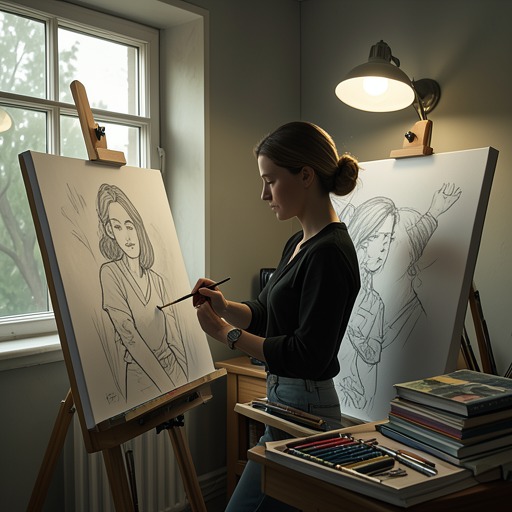
The collaboration also reverses the usual distance between artistic observer and observed subject. Jungkook’s attention is not innocent or impersonal: Shelby senses the intensity of his gaze while she works on her drawing, and his concentration falters when his breathing becomes uneven. Desire enters the making of the project, but it remains intertwined with restraint and technique. The finished images are shaped by a gaze that is intimate without being presented as merely clinical or anonymous.
At the end of the session, Jungkook shows Shelby the photographs he has taken. She is too impressed by his talent to answer immediately, then tells him that the images are beautiful. Her response confirms that the project is not simply an exercise in his authorship. Shelby evaluates what he has made and recognizes herself within it, while Jungkook receives acknowledgment from the person whose presence gave the work its subject and emotional charge.
Intimacy and Safety
The project’s significance is sharpened by the contrast between its controlled acts of looking and the moments when Shelby loses control of her own body. In an art class, pain spreads through her body, her heart races and tightens, her breathing accelerates, and she leaves the room in panic. Cassiopée follows her but cannot initially find her; when she eventually reaches Shelby and places hands on her shoulders, Shelby cries out and pulls away, recoiling from touch even after she recognizes Cassiopée.
A similar crisis occurs later when Madison encounters Shelby in a bathroom. Images associated with pain and water return, Shelby collapses, covers her ears, and begs not to be touched or harmed. Madison understands that Shelby is having an anxiety attack and goes to find Jungkook. He runs to Shelby, sits beside her, draws her close, and calms her until her breathing returns to normal. These scenes give the photography project an ethical tension: Shelby is not simply a passive image for someone else’s gaze. Her ability to be seen depends on whether touch, proximity, and attention remain responsive to her boundaries.
Jungkook’s behavior around Shelby’s distress also differs from the forced contact that intensifies her panic. At Knock Out, he finds her trembling and crying in the showers after Chen leaves. Unsure how to help, he turns off the water, crouches before her, and stays nearby without trying to impose a solution, waiting for her to calm down. Later, when Shelby sees the severity of her injuries in a mirror and slides to the floor in tears, Jungkook approaches, crouches, and places his right hand on her knees as she seeks comfort. The project’s repeated acts of posing and touch acquire their meaning against these earlier scenes, where trust must be offered carefully rather than presumed.
Recognition and Exhibition
When Shelby and Jungkook bring their book to their instructor, Madame Clark greets them and calls the project fantastic. Her praise identifies specific qualities rather than offering empty approval: the different scenes, clothing choices, and expressions on their faces make the whole presentation powerful, while the photographs convey the beauty they intended to transmit. Most significantly, she praises the notion of intimacy they have established.
The teacher’s response confirms that their private closeness has become legible as a deliberate artistic structure. Intimacy is not merely an accidental by-product of their romance; it is the project’s organizing principle, visible in the relationship between setting, costume, facial expression, and the distance between bodies. The work gives an aesthetic form to a bond that exists simultaneously as affection, desire, uncertainty, and mutual exposure.
Madame Clark then asks whether they would like to participate in the photography exhibition at the end of the year. The invitation raises the stakes of the project. Shelby immediately looks to Jungkook, while he weighs the decision and silently asks whether she is willing to commit to it. She worries that public display will expose not only Jungkook to the students of Central Washington University, but also herself. The teacher allows them time to decide, so the exhibition remains an invitation rather than an imposed consequence.
Meaning in the Story
Projet photographique de Shelby et Jungkook converts a relationship founded amid trauma, hesitation, and physical vulnerability into an object that can be shared with a wider community. Its development parallels the couple’s movement toward trust: Shelby agrees to be seen, Jungkook learns to guide without overwhelming, and both discover that their private perception of one another can produce something coherent and beautiful.
The project also preserves the tension between visibility and danger. Shelby’s panic attacks show how quickly attention and touch can become threatening, whereas the photographic sessions make looking gradual, collaborative, and purposeful. The camera does not solve her anxiety, but the project creates a space in which being observed can be negotiated rather than suffered as an attack. Its exhibition possibility extends that negotiation from the intimate space between two people to the public world of the university.
For Jungkook, the work demonstrates an ability to create through patience and attentiveness rather than through the violence associated with other parts of his life. For Shelby, it offers a form of participation in which she is not reduced to the traces of her pain. She is a model, a collaborator, an evaluator, and a person whose consent shapes the work. The project’s decisive achievement is therefore not only that its photographs are praised, but that it gives their developing relationship a visible form without separating beauty from the difficult labor of trust.